Some links on this page are affiliate links. If you buy through them I earn a small commission at no cost to you. As an Amazon Associate I earn from qualifying purchases.
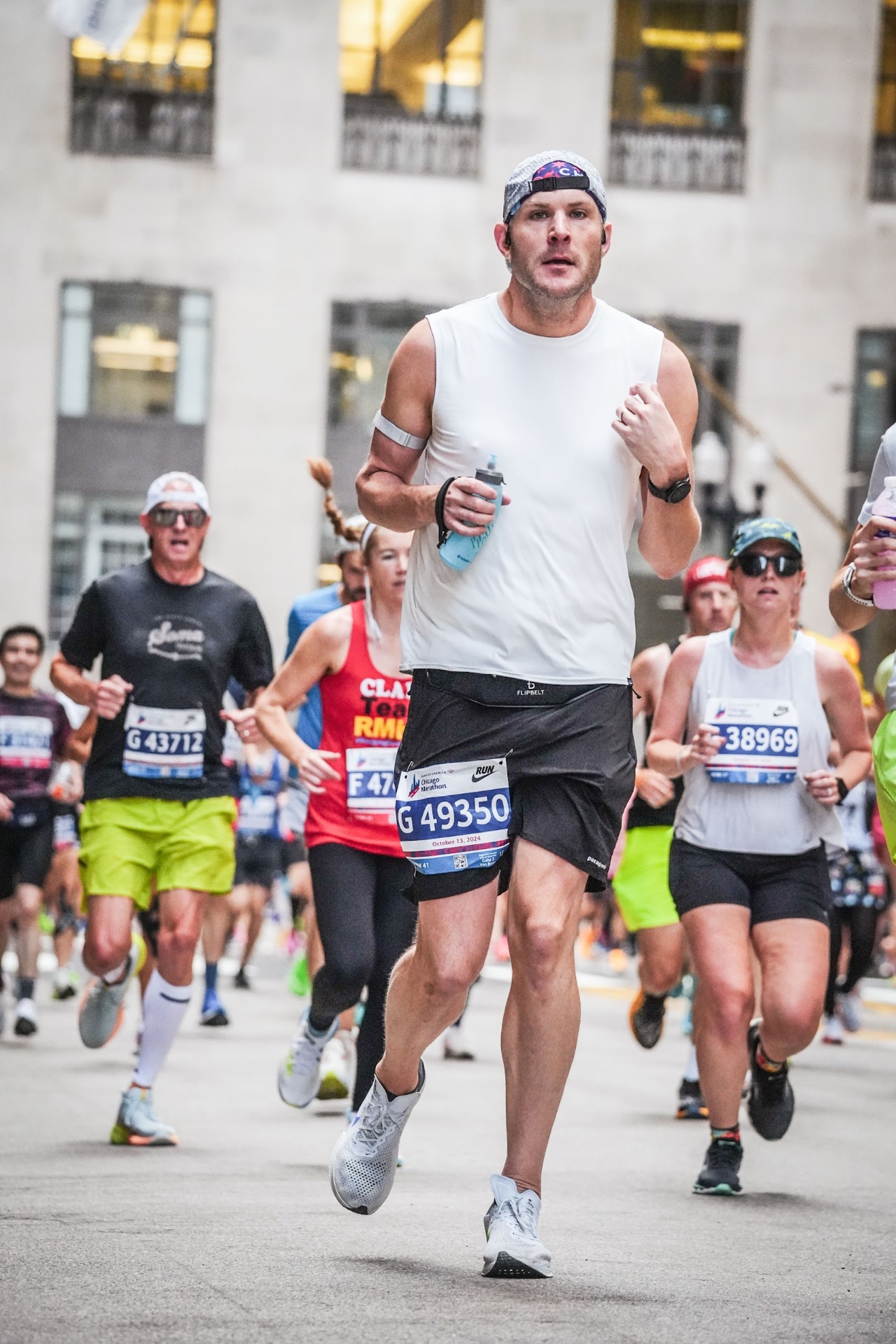
Everything here is gear I actually run in. No fluff, no sponsored picks. Just what works. I built this list during an 18-week marathon training block on the crushed limestone of the Illinois Prairie Path and the Great Western Trail, and wore most of it to a 3:54:39 marathon finish in 2024. It has been tested through summer humidity, urban GPS interference, and fall race day weather that can swing in either direction.
Shoes
- ASICS Superblast 2.0 / 3.0 My do-everything trainer. Fast enough for tempo work, cushioned enough for 20-milers, durable enough that I don't think twice about putting it on for any run. I've even considered toeing the marathon start line in it. For crushed limestone rail-to-trail running on the Illinois Prairie Path and Great Western Trail it's been flawless. If you're only buying one shoe, this is the one.
- Brooks Glycerin 22 My super easy day shoe. A standard, reliable running shoe I reach for when the effort is genuinely easy and I want something that feels different from the Superblast. Good rotation shoe if you're logging high mileage.
- Nike Vaporfly 3 What I wore to a 3:54:39 marathon finish in 2024. Fast, locked in, does exactly what a race shoe should do. If you're still figuring out pacing in them, the pace calculator is a good place to plan splits.
- Adidas Adizero Adios Pro 4 What's going on my feet for my next marathon. Haven't raced in them yet, that's the plan. Everything about them points to being the right call.
- ASICS Novablast 5 daily / easy / medium-long volume. My daily driver for easy days and medium-long volume. The Novablast 5 switched to FF Blast Max foam this year, so it's softer and bouncier than the 4 without picking up weight. It still lands around 8.8 oz with a 41.5mm heel stack, which gives you max cushion that doesn't feel like a brick underfoot. The wider toe box is a real fix if the 4 ever felt narrow to you. It's not a speed shoe and I don't pretend it is, but for racking up volume on the Prairie Path it's exactly what I want. One cold weather note: the foam firms up in the cold, so it runs a little less lively on January mornings. Mine still feel fresh deep into a run, which is the whole point of a daily trainer.
Watch & Heart Rate
- Garmin Forerunner 965 My watch for the 2024 marathon and every run since. I loved it so much that when mine broke I bought the exact same model without a second thought. Battery life is the headline feature, never a concern on long runs or race day. I use the morning report, training load, and HRV status daily. The GPS had minor issues in downtown urban canyons and showed 26.7 miles total on marathon day, which is typical for dense city courses. For a full breakdown of how to handle GPS gaps in urban environments, see the Watch and Tech Guide. For everything else it's rock solid.
- Polar Verity Sense Replaced a Coros HR monitor that kept glitching. The Polar does its job without drama. Paired with the 965 on every run.
Race Day Setup
FlipBelt Classic XL I wear this on every single run. Carries gels, phone, and whatever else I need without bouncing or shifting. XL is based on waist size, size accordingly. I tried the adjustable velcro version and it failed. The OG belt has never failed me.
Bib placement: Pin your bib visibly to the front of your outer layer with all four pins. Do not fold, cut, laminate, or cover it. Keep it off your fuel belt or pack, especially anything carrying electronics, so you do not interfere with the MYLAPS ThinTag timing chip.
HydraPak SkyFlask Speed 500ml This one changed my race day. Instead of hitting every aid station and dealing with the chaos of grabbing cups at speed, I carried a handheld with BPN G1M Sport mixed to the right carb concentration for the conditions. Carried it from the start until mile 25 when I handed it back to my wife. She also met me at mile 12 with a fresh bottle. Took away the anxiety of fueling logistics completely. A good strategy for any runner who wants more control over hydration, not just experienced runners.
BPN G1M Sport What went in the bottles. I used the Precision Hydration online calculator to dial in the right carb and electrolyte mix for hot weather. Started with BPN, it works for my stomach, and I've never switched. If it works in training, don't change it on race day.
Balega Blister Resist Socks My first half marathon I had terrible blisters. I switched to Balega Blister Resist and haven't had a single blister since. I wear no other sock for training. That's the whole review.
Balega Hidden Comfort Socks Carbon plate shoes have tighter toe boxes, and the Blister Resist is thick enough to create a snug fit that can cause issues on race day. I switch to the Hidden Comfort for race day. Low profile enough to fit cleanly inside a carbon shoe without adding bulk or pressure. Same Balega quality, just less sock where you need it.
Shokz OpenFit I moved to the OpenFit after my OpenRun pair broke, and the sound is the first thing you notice. Clearer and fuller than the OpenRun, no contest. These are open-ear, not bone conducting, so if you never loved the buzz of bone conduction, this is a completely different feel. They hook over your ear and sit just outside the canal, and you still hear cars, other runners, everything around you. That's the whole reason I run open-ear in the first place. My one gripe: on hot days sweat runs down and a few drops find your ear canal. The OpenRun never did that. So I'm splitting the rotation. OpenFit for daily runs, OpenRun for the long sweaty ones once my warranty replacement shows up.
Shokz OpenRun On my ears for every run. Used to have the OpenRun Pro, genuinely cannot tell the difference, so I went back to the standard model. Easy runs get podcasts and audiobooks. Tempo runs and races get music. Open-ear design means you stay aware of your surroundings, which matters on any shared trail.
Patagonia Capilene Cool Daily Sleeveless Shirt What I raced the 2024 marathon in. Singlets don't fit my frame so I run in sleeveless shirts. This one held up through a full marathon in warm weather without issue. REI is the most reliable place to find it.
Patagonia Multi Trails Shorts 8" I own five pairs. Being tall I need the slightly longer inseam and the 8" works. The liner is a short style which I prefer. Five pairs tells you everything you need to know.
Hanes Men's EcoSmart Sweatshirt A cheap throwaway layer for the corral. Warm enough to take the edge off a cold race morning, cheap enough to leave on the ground at the start.
Head to Toe
RNNR Crew Hat XL My go-to running hat. Fits well on a larger head, dries fast, easy to clean, and doesn't look ridiculous off the course. XL is the move if you've struggled with running hats fitting properly.
Junk Headband Lightweight, stays in place, wears under the hat. If you're running in a RNNR hat this is the combo.
Off the Run
Alter Ego Coaster Hat XL Not a running hat but worth mentioning. XL fits a larger head properly, which is rare. I wear these constantly when I'm not running.
A note on how I pick gear: I'm not a gear obsessive. I find something that works and I stick with it. The Balega socks are a perfect example, one bad blister experience at my first half marathon and I never ran in anything else again. The Garmin broke and I bought the exact same model without looking at alternatives. That's the level of trust I have in everything on this list. If something stops working, it comes off the list.
If you have questions about any of this gear in the context of training or race day, feel free to reach out at hello@chi.run.