
By Alex Smith
The 2026 Chicago Marathon delivered record setting performances, massive crowds, a few welcome course improvements, and a whole lot of suffering under the October sun. Here's what stood out from the 48th running of the race, including my own experience of watching a promising marathon unravel after mile 18.
Chicago is supposed to be a fast marathon. Flat course, incredible crowds, cool October weather. It's why runners from around the world come here looking for personal records.
Two out of three isn't bad.
On Sunday, October 11, more than 54,000 runners took to Chicago's streets for the 2026 Bank of America Chicago Marathon. The crowds were outstanding, the course was as flat as advertised, and the elite field produced some remarkable performances.
The weather? Not so much.
What started as a relatively comfortable morning turned into a warm, sunny race with very little relief from the elements. For runners still on the course late in the morning and into the afternoon, the combination of rising temperatures, direct sunshine, and accumulating fatigue made for a difficult second half.
I was one of them.
I came into Chicago hoping to break 3:40. I finished in 4:14:04, with a 30 minute positive split and a lot of walking between miles 20 and 24.
Not exactly the race I spent four months training for.
But after a few days to recover, look through the data, and read what other runners experienced, I have plenty of thoughts about what went right, what went wrong, and what I'll remember about Chicago 2026.
First, the elites put on a show
While plenty of recreational runners were battling the conditions, the elite field was busy producing one of the fastest days in Chicago Marathon history.
Kenya's Amos Kipruto won the men's race in 2:01:09, the second fastest marathon ever run on American soil. After finishing third in Chicago in 2024 and second in 2025, he finally got his win.
On the women's side, Ethiopia's Hawi Feysa defended her title in 2:13:33, holding off Sharon Lokedi (2:14:07) and Brigid Kosgei (2:14:55). For the first time in marathon history, three women broke 2:15 in the same race.
The American performances were impressive, too.
Clayton Young finished seventh overall in 2:05:23, becoming the second fastest American marathoner ever on a record eligible course. Charles Hicks followed in 2:05:35.
And then there was Vinny Mauri.
If you follow running social media, you probably know Mauri as the self coached runner from Ohio who does most of his training on Planet Fitness treadmills. No elaborate altitude camp. No massive coaching operation. Just a guy putting in serious mileage at a gym that costs about $25 a month.
Mauri went out aggressively, running on American record pace through much of the race before hamstring cramps derailed his effort late. He still finished 10th overall in 2:06:45.
It's hard not to root for that guy.
The wheelchair divisions delivered history as well. Marcel Hug set a men's course record of 1:21:34, while Catherine Debrunner broke her own women's world record in 1:33:16.
For a day that was less than ideal for marathon running, the professionals certainly made it look otherwise.
The crowds: Chicago at its best
I've run Chicago before, including in 2024, and the crowds are always one of the biggest reasons to come back.
But 2026 felt particularly good.
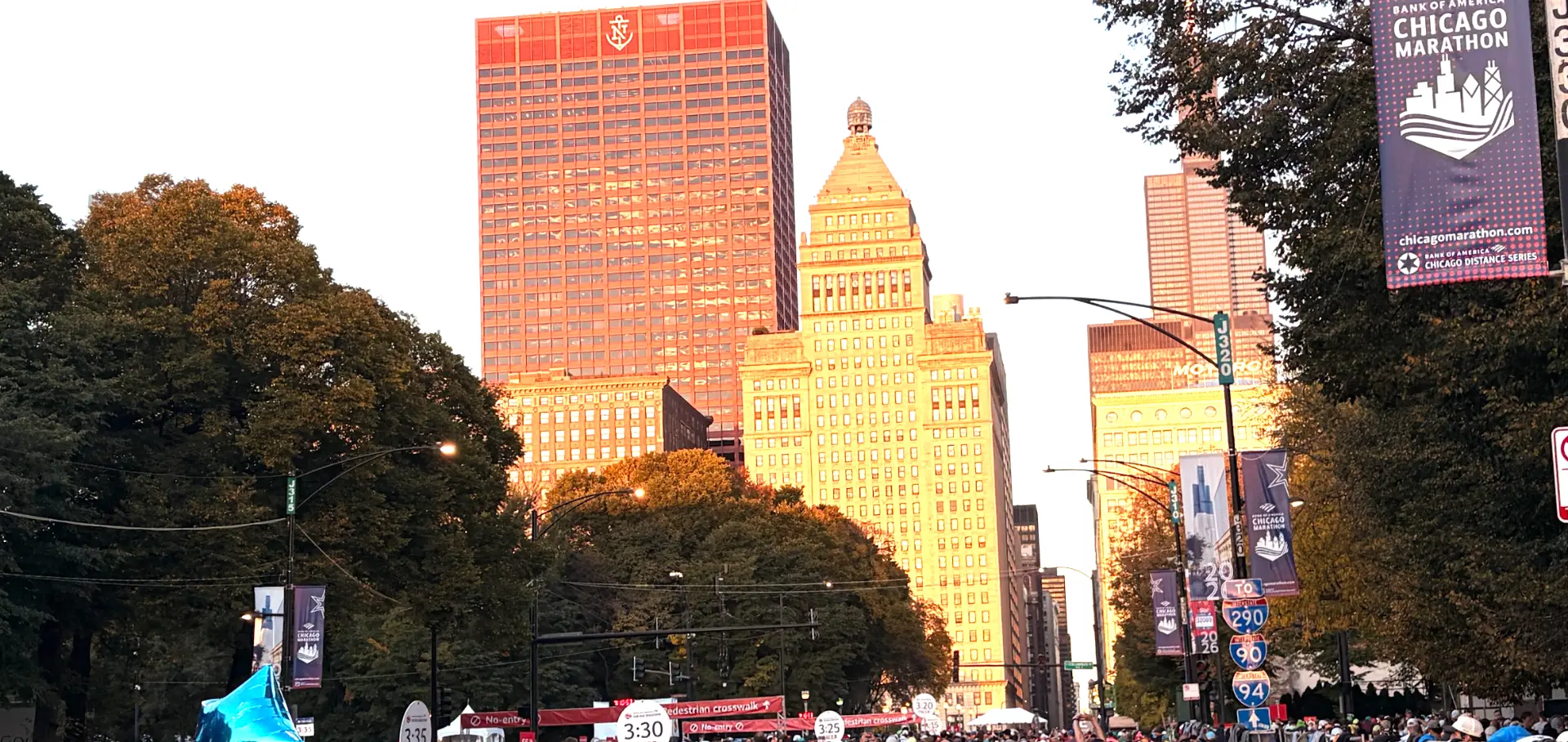
Downtown was packed from the start. After emerging from Lower Wacker, the crowds along Grand, Dearborn, and LaSalle were already several people deep. By the time we reached the 5K mark, spectators were lining both sides of the street and even the center islands.
One of my favorite sections was the turn from Sheridan onto Broadway around mile 8.
The energy through Wrigleyville and Boystown was ridiculous. Bars, restaurants, sidewalks, balconies. People everywhere, screaming nonstop. That stretch carried us almost all the way back toward Old Town.
River North was another highlight, with crowds five to seven deep approaching the halfway point. The Bank of America cheer zone near Wacker was one of the loudest spots I remember.
And then there's Chinatown.
The turn onto Wentworth around mile 21 might be the single loudest corner of the entire course. Spectators were packed 10 to 15 deep, and for a brief moment, it felt like someone plugged me back into a charger.
Unfortunately, that boost lasted about a quarter mile.
Chicago's crowds are incredible, but they're not evenly distributed. The West Side approaching the United Center, Inner Lake Shore Drive, and the long stretch down Michigan Avenue are still relatively quiet.
Those are also some of the places where you need the support most.
The weather: A beautiful day to watch a marathon
Let's talk about the elephant in the room.
Sunday was gorgeous.
If you were standing on a sidewalk with a coffee, cheering on runners, you couldn't have asked for a much nicer October day in Chicago.
If you were running 26.2 miles, it was a different story.
Temperatures were in the low 60s when I started and had climbed into the upper 70s by the time I finished shortly after noon. There wasn't a cloud in the sky.
I first noticed the heat around mile 7 on Inner Lake Shore Drive. With no buildings to the east blocking the sun, the entire stretch was exposed.
My heart rate was already running higher than expected, and my legs felt heavier than they should have at that point.
Things got progressively worse as the morning went on.
The tree lined streets around Sedgwick provided some relief, but by the time we reached the United Center around 25K, shade was becoming increasingly difficult to find.
Jackson heading east was brutal. You're running directly into the sun with very little protection.
And Michigan Avenue?
Forget about it.
I was out there between roughly 11 AM and noon, when the sun was high overhead. The long, exposed stretch south toward 35th Street felt endless.
The race organizers had cooling sponges available, residents were running sprinklers, and a fire truck was spraying water over the course near the 30K timing mat.
All of it helped.
None of it changed the fact that we were running a marathon in conditions considerably warmer than most of us had hoped for.
Reading through post race discussions, I saw plenty of similar stories. Runners described elevated heart rates, early fatigue, cramping, and race plans that fell apart somewhere between miles 16 and 22.
Of course, plenty of people still ran personal records. The elite results alone make that obvious.
But for those of us who struggled, the sunshine was a major part of the story.
My race: Everything was fine until it wasn't
I came into this race feeling reasonably prepared.
My training had gone well. I'd completed multiple 19 and 20 mile runs, including a final 20 miler with 8.5 miles at marathon pace late in the run. I'd practiced fueling, worked through my taper, and had a pacing plan that I thought was realistic.
I was aiming for a sub 3:40 finish, roughly 8:23 per mile.
I also knew that my heart rate would be the biggest variable.
Race morning itself went about as smoothly as possible. I was dropped off near Wells and State around 5:45 AM, walked into Grant Park, and cleared security almost immediately.
I had time to use the bathrooms, check my gear, and sit down before heading into Corral E.
The only real headache was the lack of urinals. By 6:50 AM, the bathroom lines were getting ugly, and runners were using the bushes and corral fences.
Fortunately, when our corral moved into the former Corral A staging area, staff opened access to the porta potties. I managed one final bathroom stop before crossing the starting line around 7:56 AM.
From there, the first few miles were relatively uneventful.
GPS was predictably unreliable downtown, so I used the course mile markers rather than trusting my watch's instant pace.
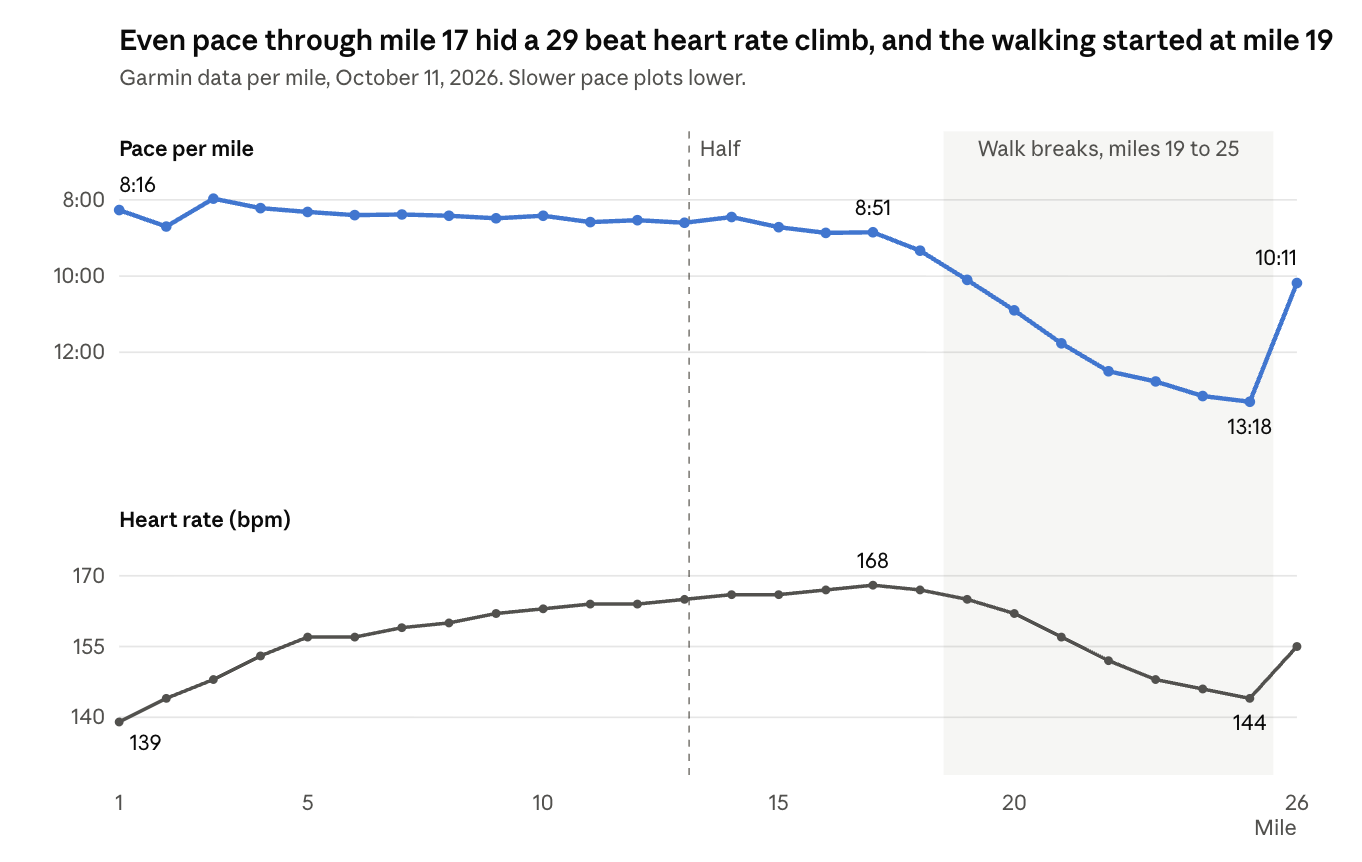
My pacing was actually pretty consistent. From 5K through 25K, my average pace across each 5K segment ranged from 8:26 to 8:46 per mile.
But there was a problem.
My heart rate was already 153 by mile 4.
That's much higher than I wanted that early in a marathon.
I tried backing off the pace to bring it down. It didn't really work.
By mile 6, my legs were already feeling heavier than they should. By mile 7, I was noticing the heat. And by the halfway point, I knew I wasn't having the kind of day I'd planned.
I crossed halfway in 1:51:59.
That wasn't an unreasonable split by itself. The problem was how much effort it was costing me.
Around mile 17, the muscular fatigue started becoming much more noticeable. My quads were getting increasingly uncomfortable, and I was feeling pain through my hamstrings and glutes, particularly on the left side.
By mile 18, the wheels were coming off.
This wasn't the classic sensation of running out of fuel. I'd been taking gels approximately every 20 minutes, drinking carbohydrates from my handheld bottle, and staying on top of fluids.
My legs simply stopped cooperating.
Running became painful. Walking relieved the discomfort. Every time I tried to get going again, the pain returned.
By mile 20, I was walking significant portions of the course.
My slowest stretch came between the 35K marker and mile 22, when my pace dropped to roughly 14:44 per mile.
That is a long way from 8:23.
The most frustrating part was that I didn't feel completely exhausted in the traditional cardiovascular sense. I could breathe. I could think. I wasn't dizzy or nauseated.
But my legs were done.
Somewhere around mile 24, after enough walking to let my heart rate settle into the mid 140s, I was finally able to start running more consistently again.
I ran the last couple of miles progressively faster and managed to finish reasonably strong.
Final time: 4:14:04.
A 1:51:59 first half and 2:22:05 second half.
Thirty minutes of positive splitting.
Ouch.
What actually happened to my legs?
This is the part I've spent the most time thinking about since Sunday.
Initially, I wondered whether I had simply gone out too fast, taken in too much fluid, or messed something up with my fueling.
After looking at the splits, my heart rate, and the way the pain developed, I think the explanation is more complicated.
My best interpretation is that I accumulated muscular fatigue much faster than expected, likely accelerated by the warm conditions and an effort level that was too high early in the race.
Even though my pace looked controlled, my body was working harder than it should have been.
That additional effort added up over the first 16 to 18 miles.
Eventually, my legs reached a point where they couldn't comfortably sustain the repeated impact and muscle contractions required to keep running.
The quadriceps, particularly the outer portions of both thighs, took the worst of it. I also experienced significant hamstring and glute discomfort.
The fact that walking helped, and that I could resume running after slowing down considerably, suggests that muscular fatigue and pain were major limiting factors.
It doesn't prove a specific physiological cause, but it fits what I experienced.
I also have to acknowledge something uncomfortable.
This is the second Chicago Marathon where I've struggled badly in the final third.
In 2024, I finished in 3:54:39. This year, despite more experience and a serious training block, I finished nearly 20 minutes slower.
At some point, I have to stop treating these as isolated bad days and start asking whether my training and race strategy are properly matched to my current fitness.
That's probably the biggest lesson I'll take into the offseason.
The best course improvement: Culligan refill stations
Now for something that worked exceptionally well.
The new Culligan bottle refill stations were fantastic.
I carried a handheld bottle throughout the race and planned to refill it rather than rely entirely on traditional aid stations.
There were four refill locations along the course, around miles 5.7, 10.1, 16, and 20.5.
I used the final three.
Each station had roughly 30 spigots, and when I arrived, only a fraction were occupied. The water pressure was strong enough to fill my bottle in about two seconds.
Including slowing down, stopping, and getting moving again, each refill cost me approximately 10 seconds.
Three refills. About 30 seconds total.
That's a massive improvement over trying to refill a bottle from paper cups while dodging runners at crowded aid stations.
I still used some on course water for cooling, but the refill stations handled my primary hydration needs.
One thing I may reconsider is how much fluid I actually consumed. Between the refills, the carbohydrate drink I carried from the start, and additional water, I may have taken in more than necessary.
I don't think fueling was the reason my race fell apart, but hydration volume is worth reviewing.
For runners who carry their own bottles, the refill stations are one of the best additions I've seen to the Chicago course.
I hope they're here to stay.
A few course observations worth remembering
There were several smaller things about the 2026 course that stood out, especially for anyone planning to run Chicago in 2027.
The Dearborn routing: The early course turned onto Dearborn rather than State Street. It was a little more congested, particularly approaching the first aid station, but the crowds were excellent.
Lower Wacker GPS: Surprisingly, my GPS performed much better through the tunnel than it did during the Shamrock Shuffle. My first mile lap was only about 0.08 miles early, compared with roughly 0.3 miles of error at the Shuffle. Instant pace was still useless downtown.
The Halsted overpass: The small climb around mile 17 isn't much on paper, but it's enough to get your attention when your legs are starting to hurt.
The Cermak bridge: Around mile 21, the bridge crossing toward Chinatown has a sneaky climb that doesn't stand out on most course elevation profiles. It's not a big hill, but after 20 miles, it certainly feels like one.
Michigan Avenue: The stretch south of 26th Street remains one of the toughest mental sections of the race. You're heading away from the finish while watching other runners coming back north. The crowds thin out, the road feels endless, and the turn toward home can't come soon enough.
Mount Roosevelt: After everything else, that little climb at mile 26 still feels like an unnecessary personal insult.
What the running community was saying
After the race, I spent time reading reactions from other runners.
Unsurprisingly, the weather dominated many of the conversations.
There were stories of ambitious pace goals abandoned halfway through, cramps appearing earlier than expected, and runners walking stretches they had confidently expected to run.
The sun was a recurring complaint, particularly from runners who finished later in the morning or afternoon.
The size of the field also came up frequently.
With more than 54,000 finishers, Chicago is an enormous event. The opening miles were crowded, and navigating aid stations, sudden pace changes, and other runners required patience.
Some runners complained about people stopping abruptly, using phones while running, or blocking the course.
Those are legitimate frustrations, especially when you're trying to maintain a consistent rhythm.
But the overwhelming positive theme was the support.
The crowds, volunteers, neighborhood organizations, and complete strangers handing out water or running sprinklers made a difficult day considerably better.
It's one of the things Chicago consistently gets right.
What I'll change for my next marathon
I'm not ready to write a full training plan for 2027. My quads are still reminding me that I ran a marathon three days ago.
But I already know a few things I want to approach differently.
First, I want to make heart rate a much bigger part of my race strategy.
I've spent too much time chasing a specific pace and hoping my cardiovascular effort will cooperate.
Next time, I'd rather start conservatively, even if that means running the opening miles around 9:00 per mile, and gradually increase the effort if the conditions and my body allow it.
I'd much rather reach mile 20 with something left than reach mile 18 already negotiating with my legs.
Second, I need to take strength training more seriously.
I've done a reasonable job building running mileage and endurance, but my muscular durability clearly needs attention. That means more consistent work on my quads, glutes, hamstrings, calves, and overall lower body strength.
Third, I need to better understand the relationship between heat, heart rate, and sustainable marathon effort.
I've seen it repeatedly in training. When the dew point climbs, my heart rate rises and my pace suffers.
Sunday reinforced that lesson on a much larger stage.
And finally, I need to be more willing to adjust expectations before the race starts.
There's a difference between giving yourself a chance to run a personal record and stubbornly pursuing a pace that the conditions don't support.
I probably crossed that line earlier than I realized.
Final thoughts: Chicago is still Chicago
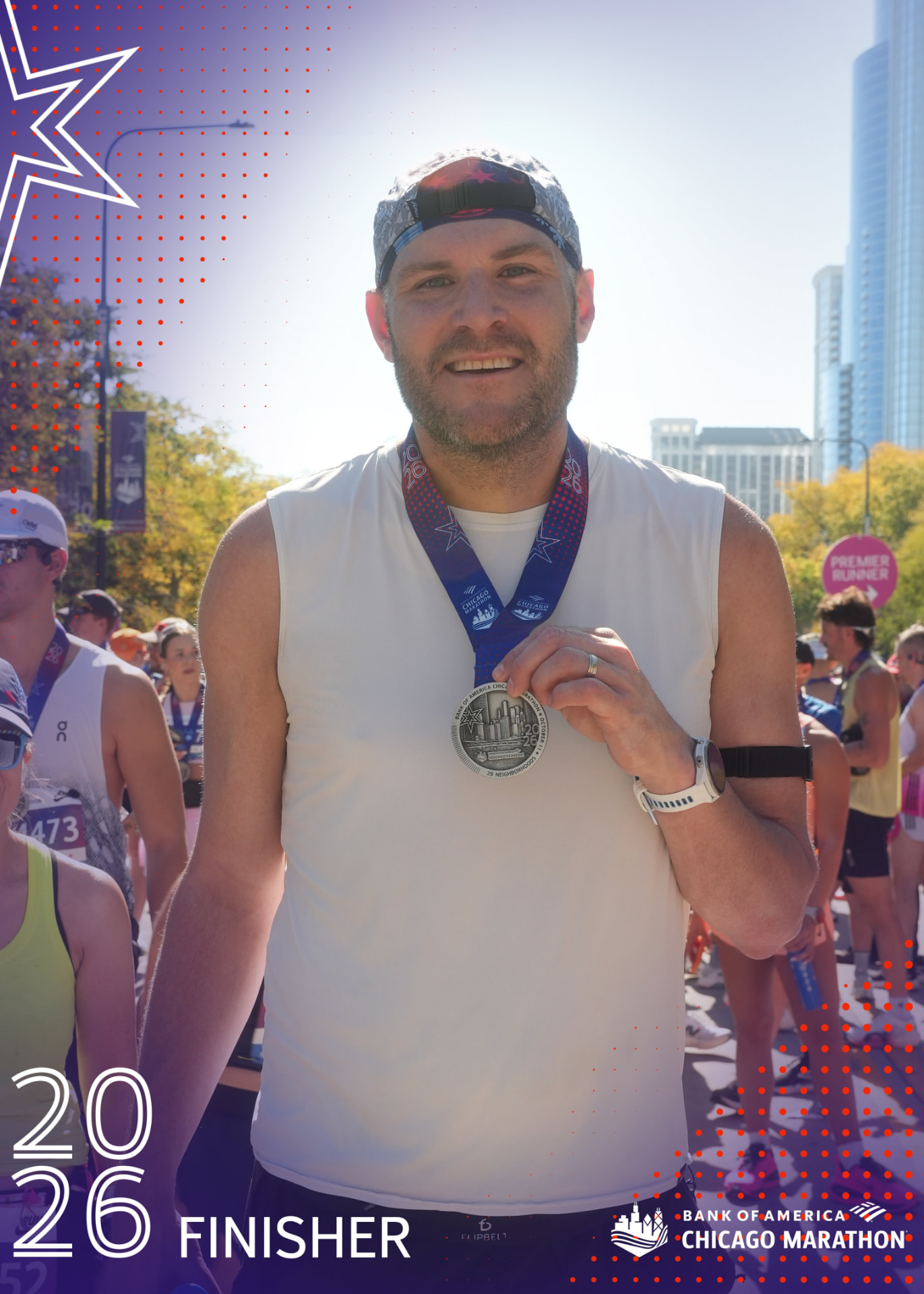
Three days later, I'm still disappointed with my performance.
I trained hard, put in the miles, practiced my fueling, and showed up believing I could run considerably faster than I did.
Instead, I spent much of the final 10K walking through Chicago, wondering how a race that started so normally could fall apart so completely.
But I also remember the incredible crowds on LaSalle, the noise through Boystown, the fire truck spraying water at 30K, and the moment I finally started running again on Michigan Avenue.
I remember how good it felt to make that final left turn onto Columbus, even if the clock wasn't showing anything close to what I'd hoped.
And I remember why I wanted to run Chicago in the first place.
It's an incredible city to run through. The neighborhoods, the volunteers, the spectators, and the sheer scale of the event make it special, even when your own race goes sideways.
The 2026 Chicago Marathon wasn't my day.
For plenty of runners, it wasn't theirs either.
But for others, it was the race of a lifetime. Personal records, first marathons, breakthrough performances, and memories they'll carry for years.
That's what makes a marathon interesting. We all run the same 26.2 miles, but nobody has quite the same experience.
As for me, I'll recover, figure out what needs to change, and eventually start training again.
I have some unfinished business with this course.
And apparently, with mile 18.